Cyprus Natural Gas Could Reach Europe by 2028 as Eastern Mediterranean Gains Strategic Importance
- Founder & Editor, EuroBankingNews
- vor 10 Minuten
- 2 Min. Lesezeit
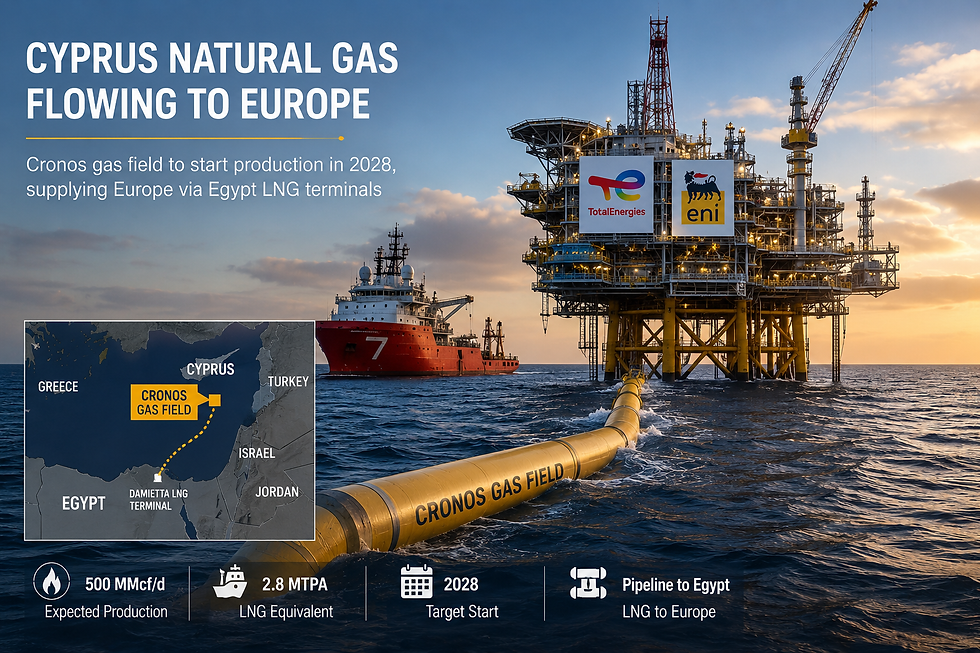
Cyprus is moving closer to becoming a new energy supplier for Europe, with Cyprus natural gas Europe plans gaining momentum after TotalEnergies and Eni approved the development of the Cronos offshore gas field. Production is targeted for 2028, potentially giving European markets another source of natural gas as the region continues to diversify its energy supplies.
The Cronos field, located in Cyprus’ offshore Block 6, is expected to produce around 500 million cubic feet of gas per day, equivalent to approximately 2.8 million tonnes of liquefied natural gas (LNG) annually. The project is being developed by TotalEnergies and Eni, which each hold a 50% interest, with Eni acting as operator.
The route to European consumers is particularly significant. Instead of building a completely new export chain, gas from Cronos will be transported through a subsea pipeline to Egypt, where it will be processed and liquefied at the existing Damietta LNG facility before being shipped to European markets. Using existing infrastructure is expected to reduce development costs and accelerate the project's delivery.
For Europe, the Cyprus natural gas Europe connection comes at a strategically important moment. The EU has spent years reducing its dependence on Russian energy supplies, while instability in the Middle East has created additional uncertainty across global energy markets. New LNG sources from the Eastern Mediterranean could therefore provide another layer of supply diversification.
The project also strengthens Cyprus' ambitions to become part of a broader Eastern Mediterranean energy hub. Other offshore discoveries could eventually add further volumes. ExxonMobil and QatarEnergy are progressing plans for the Glaucus and Pegasus discoveries, although those projects are expected to come later, with potential production currently projected for the early 2030s.
From an economic perspective, the development could be important for Cyprus beyond direct gas revenues. Offshore energy investment can generate demand for engineering, maritime services, infrastructure and financial services while increasing the country's strategic relevance to European energy policy.
For European energy markets, however, Cronos will not fundamentally replace existing suppliers. Its expected production is relatively modest compared with total European gas consumption. Its importance lies instead in diversification, flexibility and the creation of another regional supply route.
The project also illustrates how existing LNG infrastructure is becoming increasingly valuable. By connecting Cypriot offshore resources with Egypt's established processing facilities, companies can avoid the much higher costs and longer construction timelines associated with creating an entirely new export network.
Looking ahead, Cyprus natural gas Europe flows could become a meaningful component of the continent's energy diversification strategy. The first challenge is now execution: bringing Cronos into production on schedule while maintaining commercially viable costs. If successful, Cyprus could move from being a promising offshore exploration market to becoming a recognised contributor to Europe's energy security.
Source: Associated Press / Yahoo News; TotalEnergies.


Kommentare