ECB Launches Pontes as Wholesale Digital Euro Enters Tokenised Markets
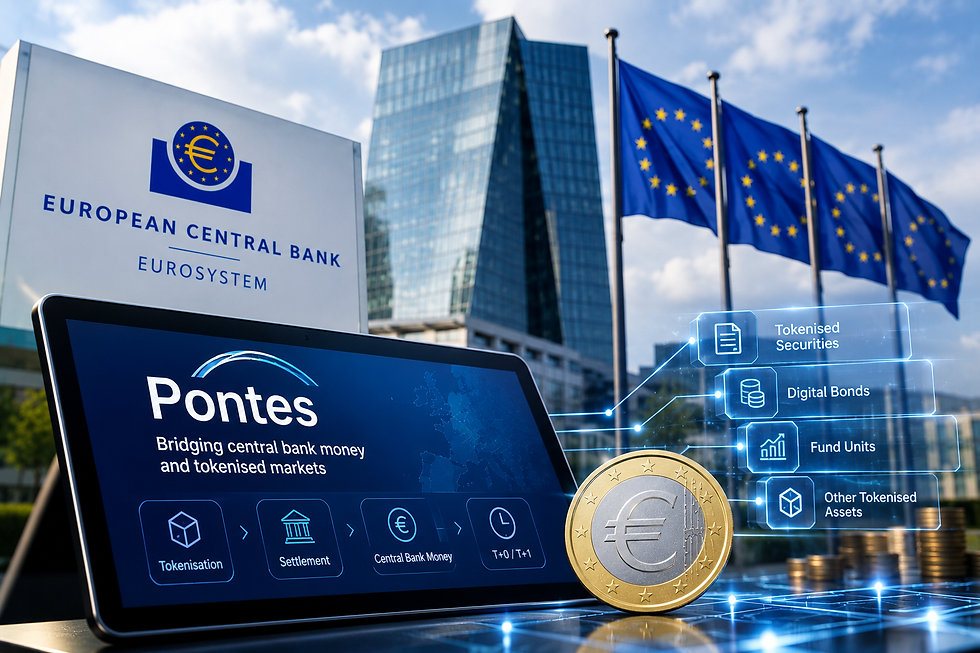
The European Central Bank (ECB) has taken a major step into tokenised financial markets, launching Pontes, a new settlement system that allows wholesale transactions in tokenised assets to be settled using central bank money.
The move marks the first operational step in the Eurosystem's strategy to adapt central bank money to financial markets increasingly built around blockchain and distributed ledger technology (DLT).
Importantly, Pontes should not be confused with the retail digital euro being developed for consumers. Pontes is designed for banks, financial institutions and wholesale markets, while the retail digital euro remains dependent on European legislation and is currently being prepared for a potential launch later this decade.
ECB Brings Central Bank Money to Tokenised Finance
Pontes connects DLT-based market infrastructures with the Eurosystem's existing payment infrastructure, allowing tokenised transactions to settle in central bank money.
Tokenisation involves representing financial assets such as bonds or other securities as digital tokens recorded on distributed ledgers. The technology could combine several stages of the financial-market lifecycle, including issuance, trading, settlement, custody and servicing, potentially reducing processing times and operational costs.
The ECB sees access to central bank money as particularly important because it provides a settlement asset without the credit risk associated with commercial-bank money or privately issued digital currencies.
This creates a potential alternative to settling tokenised transactions through private stablecoins or other digital settlement assets.
Major European Banks Join the Platform
Pontes is launching with a significant group of financial institutions and technology providers.
The initial market participants include Deutsche Bank, Santander, Société Générale, DZ Bank, DekaBank, BayernLB, European Investment Bank, KfW and NRW.BANK, among others. DLT market operators joining the system include Clearstream, Axiology, Cashlink and SWIAT. The Deutsche Bundesbank has also onboarded as a market participant.
The initial group demonstrates that the project is not limited to central-bank experimentation. Commercial banks, public-sector institutions and market infrastructure providers are participating in the development of a European tokenised-finance ecosystem.
The ECB expects additional participants to connect in the coming months.
ECB to Invest in Tokenised Securities
The ECB is also taking a practical step as an investor.
The central bank announced that it has started preparations to invest a small portion of its own funds in tokenised securities. The purchases are intended to give the ECB first-hand experience of the technology across the investment lifecycle, including trade execution, settlement, systems and portfolio management.
Initial investments are planned to focus on euro-denominated securities issued by euro-area governments, regional authorities, agencies and European supranational institutions.
The ECB stressed that these are tokenised securities rather than cryptocurrencies. Settlement of the transactions will take place through Pontes using central bank money.
Pontes and the Digital Euro Are Two Different Projects
The launch also highlights the two-track nature of Europe's digital-money strategy.
The wholesale track is already moving into operational use through Pontes. The retail digital euro, meanwhile, is intended to provide consumers with a digital form of central bank money for everyday payments.
The ECB says that, assuming EU legislators adopt the necessary legislation, pilot transactions could begin from mid-2027, with the digital euro potentially ready for first issuance in 2029.
The Eurosystem has already begun preparing the retail pilot, including seeking e-commerce and mobile-commerce merchants to participate in testing during 2027.
Why Tokenised Finance Matters for European Banks
For Europe's banking industry, the significance of Pontes extends beyond blockchain technology.
Tokenisation could change how securities are issued, traded and settled. If different stages of a transaction can be integrated through DLT and smart contracts, financial institutions could potentially reduce reconciliation work and shorten settlement processes.
The ECB has argued that central bank money needs to evolve alongside these technologies. Without a euro-based settlement layer, tokenised financial markets could become dependent on fragmented private settlement assets or non-European infrastructure.
That issue is particularly relevant for Europe's broader efforts to strengthen its capital markets and reduce strategic dependence on foreign payment and financial infrastructure.
Appia Will Shape the Longer-Term European Ecosystem
Pontes is only one part of the ECB's strategy.
The Eurosystem is also developing Appia, an initiative intended to explore the longer-term architecture of an integrated European tokenised financial ecosystem. The project involves central banks, regulators, market participants and other public and private stakeholders, with a blueprint targeted for 2028.
Pontes therefore provides the operational bridge between today's financial infrastructure and a potentially more tokenised market structure, while Appia addresses the broader standards, architecture and governance questions.
A New Phase for European Digital Finance
The launch of Pontes marks a significant transition from experimentation toward operational infrastructure.
For European banks and capital markets, the key question is no longer simply whether blockchain technology can be used in financial markets. The focus is increasingly on how tokenised assets can operate within regulated European infrastructure while retaining access to the safety of central bank money.
Pontes gives the euro area a concrete mechanism for testing that model.
The retail digital euro remains a separate project, but the two initiatives share a broader objective: ensuring that central bank money remains relevant as Europe's financial system becomes increasingly digital.
Source: Financial Times


Kommentare