EU and Canada Secure €211 Million for Global Ocean Observation
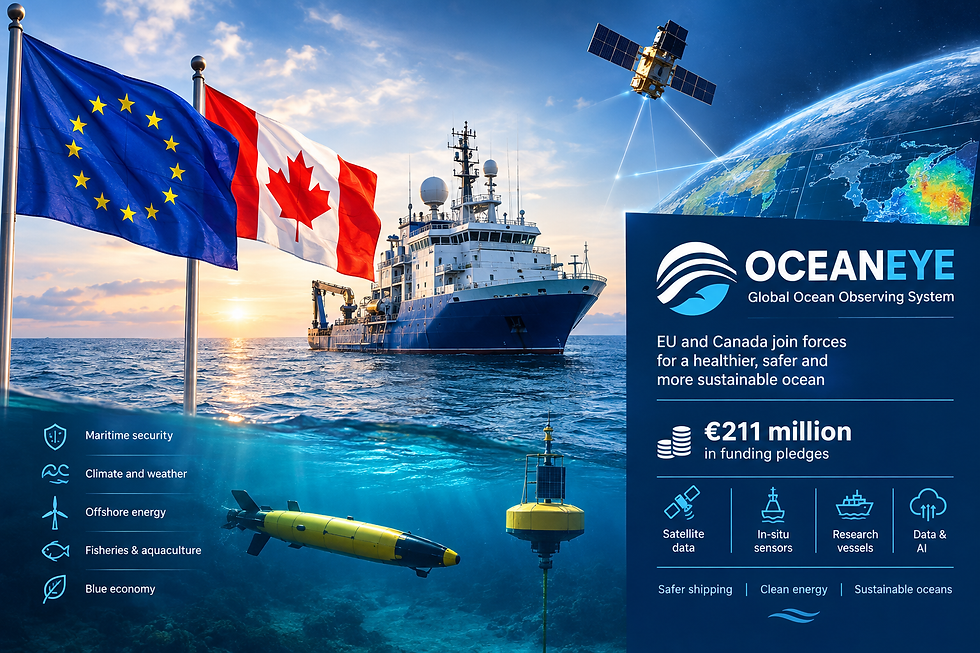
The European Union and Canada have secured at least €211 million ($240 million) in funding pledges for a new international initiative designed to strengthen global ocean observation, combining public investment with international cooperation in marine technology and data infrastructure.
The initiative, known as the OceanEye International Alliance for the Global Ocean Observing System, was launched on September 23, 2026, during the high-level week of the United Nations General Assembly in New York. European Commission President Ursula von der Leyen and Canadian Prime Minister Mark Carney co-chaired the initiative.
For Europe, the programme is more than an environmental initiative. Ocean observation supports shipping, offshore energy, fisheries, coastal infrastructure, weather forecasting, climate modelling and maritime security — sectors with significant economic and investment implications.
EU and Canada Put New Money Into Ocean Monitoring
The European Commission said the EU had increased its funding for ocean observation with a €92 million seed contribution. Canada, meanwhile, pledged C$82 million over five years, equivalent to roughly US$58 million at the exchange rate cited by Reuters.
The wider OceanEye alliance has attracted pledges from multiple countries and partners. The alliance currently comprises 30 countries plus the European Union, according to Reuters.
The money is intended to strengthen observation networks by developing new technologies and expanding equipment in areas including the high seas and space. Sensors, satellites and other observation infrastructure will generate data used by governments, researchers and companies.
Why Ocean Data Has Economic Value
Ocean observation is increasingly becoming an economic infrastructure issue.
The European Commission estimates that every euro invested in ocean observation systems can generate €5 to €6 in economic and societal benefits. Global public investment in in-situ ocean observation is estimated at roughly €0.85 billion to €1.3 billion annually, while the Commission notes that this covers only around 60% to 70% of the system's estimated requirements.
The economic applications are broad.
-Better ocean data can improve:
-shipping routes and maritime safety;
-weather and climate forecasting;
-offshore wind and other marine energy projects;
-fisheries and aquaculture;
-coastal infrastructure planning;
-environmental monitoring;
-maritime security;
-Insurance and risk assessment.
This makes ocean observation relevant not only to governments and scientists, but also to banks, insurers, infrastructure investors and companies operating in the maritime economy.
OceanEye Links Science With Europe's Industrial Strategy
The European Commission formally launched OceanEye in June 2026 with the objective of strengthening Europe's position in ocean intelligence and related technologies.
The EU aims to contribute 35% of the global ocean observing system by 2035 and secure 35% of the market for ocean observation technologies. The initiative includes artificial intelligence, autonomous sensors and digital-twin technologies.
The strategy also includes the development of a European Digital Ocean System, bringing together existing European marine information services and observation data.
A European Digital Twin of the Ocean is expected to become fully operational by 2030. Such a system could allow policymakers and businesses to model marine conditions and test scenarios using large volumes of real-world data.
For Europe's technology sector, this creates potential demand for sensors, satellites, data platforms, artificial intelligence, cloud infrastructure and specialised marine equipment.
Horizon Europe Provides the Initial EU Funding
The EU's contribution is partly linked to Horizon Europe, the bloc's main research and innovation programme.
The European Commission has allocated €50 million under the current Horizon Europe programme to strengthen the global in-situ ocean observing system. A further €12 million is intended to support resilient global ocean data systems, while additional funding supports innovation in ocean observation technologies.
The Commission's broader OceanEye programme says existing EU programmes including Horizon Europe and the European Innovation Council will provide more than €92 million across global monitoring, data systems and start-up innovation.
This illustrates how European research funding is increasingly being connected to industrial policy and strategic technology development.
Canada Expands Its Role in Global Ocean Monitoring
Canada's contribution reflects the country's extensive maritime geography and interest in Arctic and ocean observation.
Prime Minister Mark Carney announced C$82 million over five years to support ocean observation and the Global Ocean Observing System. Canada and the EU are co-chairs of the new international alliance.
The alliance is intended to address gaps in the global observation network and improve long-term financing and coordination.
According to the European External Action Service, the wider Global Ocean Observing System currently brings together 64 countries, 17 global observation networks and around 8,000 observation platforms, producing approximately 120,000 observations per day.
Satellites and Sensors Become Strategic Infrastructure
A key element of the initiative is the expansion of observation capacity both at sea and from space.
Modern ocean monitoring relies on a combination of satellites, buoys, autonomous instruments, research vessels, underwater systems and other sensors. The resulting data can then be integrated into forecasting models and digital platforms.
That creates a growing market for European companies working in space technology, telecommunications, artificial intelligence, maritime engineering and environmental data.
The European Commission has explicitly linked OceanEye to strengthening Europe's innovation and industrial base. Its strategy is intended not only to improve scientific knowledge but also to create new markets for Europe's maritime manufacturing and technology sectors.
A Growing Role for the Blue Economy
The EU's interest in ocean observation is closely connected to its broader blue economy strategy.
Shipping, offshore energy, fisheries, aquaculture and coastal infrastructure all depend on reliable information about marine conditions. Better data can reduce operational risks and improve investment decisions.
For financial institutions, this can translate into better risk assessment for infrastructure projects and more reliable information for companies exposed to weather, coastal and maritime risks.
The Commission also identifies ocean observation as important for maritime security and the resilience of coastal areas.
Europe's Ocean-Tech Ambition
The launch of the OceanEye alliance comes as Europe seeks to strengthen its position in strategic technologies and reduce vulnerabilities in critical infrastructure.
Ocean data is increasingly becoming part of that discussion.
The EU's approach combines public research funding, international partnerships and industrial development. If the strategy succeeds, European companies could benefit from demand for sensors, satellite systems, autonomous platforms, AI-powered forecasting and digital ocean infrastructure.
At the same time, the initiative highlights a broader economic trend: environmental data is increasingly treated as strategic infrastructure rather than simply as scientific information.
Outlook
The €211 million in initial pledges provides a starting point for a larger international financing effort. The European Commission and Canada want additional countries, philanthropic organisations and private-sector partners to contribute to the Global Ocean Observing System.
For Europe, OceanEye could therefore become an important intersection between climate data, maritime security, industrial policy, research funding and the blue economy.
The longer-term economic impact will depend on whether the initiative can turn public investment into sustained observation infrastructure and commercially useful technologies.
Source: Reuters, European Commission, Government of Canada, European External Action Service
Date: September 23, 2026


Kommentare