EU Backs €2.25 Billion Romanian Railway Upgrade With €630 Million EIB Financing
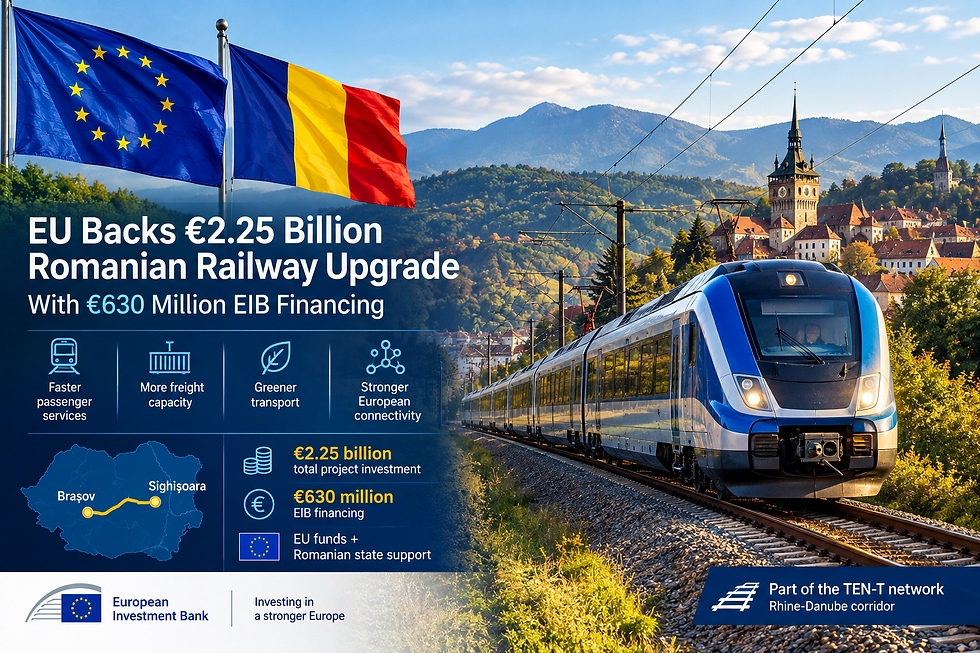
The European Investment Bank has signed a €630 million financing agreement with Romania for the modernisation of the Brașov–Sighișoara railway, supporting a wider investment worth an estimated €2.25 billion.
The project will modernise 113 kilometres of double-track, electrified railway in central Romania and is being financed through a combination of EIB financing, EU funds and Romanian state resources. The upgraded line is expected to improve passenger and freight capacity while removing a major bottleneck on two European transport corridors.
For European investors and infrastructure companies, the project highlights the continuing role of EU-backed public finance in upgrading transport networks in Central and Eastern Europe.
€630 Million EIB Financing for Strategic Rail Corridor
The European Investment Bank's financing represents a substantial share of the total project cost.
The Brașov–Sighișoara section forms part of the Rhine-Danube TEN-T corridor and is also linked to the Baltic Sea–Black Sea–Aegean Sea corridor. Its modernisation is therefore relevant beyond Romania's domestic transport network.
The project will upgrade 113 kilometres of railway to improve speed, capacity, reliability and safety.
Passenger trains will be able to operate at speeds of up to 160 km/h, while freight trains will be able to travel at up to 120 km/h. The upgraded infrastructure will also accommodate longer and heavier freight trains.
Four Million Passengers and Six Million Tonnes of Freight
The EIB expects the modernised railway to serve around four million passengers annually.
Freight capacity is also expected to increase significantly, with approximately six million tonnes of freight per yearforecast to use the upgraded route.
The project is designed to allow up to 29 passenger trains and 22 freight trains per day, increasing the capacity of an important section of Romania's railway network.
The combination of higher passenger capacity and more efficient freight transport could strengthen rail's role in Romania's domestic and international logistics network.
Why the Rhine-Danube Corridor Matters
Romania occupies an important position in the European transport network.
The European Commission identifies the Rhine-Danube corridor as one of the major TEN-T corridors crossing Romania. The network connects Central European markets with Romania's Black Sea ports and other transport hubs.
Improving the Brașov–Sighișoara section can therefore reduce a bottleneck in a route that carries both passenger and freight traffic.
For logistics companies, faster and more predictable rail connections can improve supply-chain planning. For European manufacturers and exporters, better rail infrastructure can also strengthen access to markets in Central and Southeastern Europe.
EU Funding Is Driving Romania's Rail Modernisation
The Brașov–Sighișoara investment is part of a much broader European effort to modernise Romania's railway infrastructure.
The European Commission says Romania is modernising 315 kilometres of railway through its Recovery and Resilience Plan, including the deployment of the European Rail Traffic Management System, or ERTMS Level 2.
ERTMS is designed to improve interoperability between national railway systems and can increase both capacity and operational safety.
Romania's rail network includes more than 1,800 kilometres within the European TEN-T core network corridors, making the country's infrastructure an important component of the wider European rail system.
Financing Infrastructure Through Public Capital
The Brașov–Sighișoara project illustrates how major European infrastructure projects are financed through several layers of public capital.
The €630 million EIB loan is being combined with EU funding and a contribution from the Romanian state.
This blended approach is particularly important for large transport projects because infrastructure investments often require substantial upfront capital while generating economic benefits over several decades.
The EIB also provided advisory support to Romanian authorities during the preparation and implementation of the project.
Rail Investment Supports Europe's Shift From Road to Rail
The European Union is seeking to increase the role of rail in the transport system as it works toward lower-emission mobility and greater transport resilience.
The European Commission estimates that completing the EU's trans-European high-speed rail network by 2040 would require around €345 billion of infrastructure investment. A 250 km/h network by 2050 could require approximately €546 billion.
Public funding will remain important, but the Commission is also examining ways to attract more private investment into European rail infrastructure and rolling stock.
Romania's railway projects therefore form part of a much larger European investment challenge.
Potential Benefits for the Romanian Economy
Improved rail infrastructure can affect the wider economy through several channels.
Better connections can reduce travel times for workers and passengers, improve freight logistics and increase the reliability of supply chains.
The project can also support construction, engineering, signalling and railway-equipment companies during the implementation phase.
Over the longer term, improved connectivity may make locations along the corridor more attractive for industrial investment, logistics facilities and commercial development.
For Romania, this is particularly relevant because infrastructure quality remains an important factor in narrowing the economic gap with Western European markets.
Strategic Importance for European Freight
The freight component is particularly relevant for Europe's internal market.
Longer and heavier freight trains can increase the amount of cargo transported per train, potentially improving the economics of rail freight.
The EIB expects the project to help shift transport from roads to rail while removing a bottleneck on two major European corridors.
For European logistics operators, this could strengthen rail as an alternative for long-distance freight movements between Central Europe, Romania and the Black Sea region.
Romania's Wider Infrastructure Pipeline
The Brașov–Sighișoara project is not an isolated investment.
Romania is simultaneously implementing railway upgrades on other sections of its TEN-T network, including projects involving electrification, track modernisation and ERTMS.
The European Commission's recovery programme identifies railway modernisation as a major investment area, with the objective of bringing infrastructure closer to TEN-T standards and improving interoperability across the European network.
Other major Romanian rail projects are also attracting international construction and engineering companies, reinforcing the country's position as an important market for European transport infrastructure investment.
Outlook
The €2.25 billion Brașov–Sighișoara railway investment demonstrates how EU institutions, national governments and the EIB are combining financing to upgrade strategic transport infrastructure.
The €630 million EIB loan provides a major source of long-term financing, while EU and Romanian state contributions complete the funding structure.
Once completed, the project is expected to increase passenger and freight capacity, improve journey times and remove a bottleneck on important European transport corridors.
For EuroBankingNews readers, the project illustrates a broader European trend: public investment banks and EU funding mechanisms remain central to financing the infrastructure required for Europe's competitiveness, connectivity and transition from road to rail.
Source: Global Construction Review / MegaProject, European Investment Bank, European Commission
Date: September 2026


Kommentare